going solo
The Royal Australian Air Force, 1946-1971
by Alan Stephens
The Emergency
The assassination of three British estate managers on 16 June 1948 at the
tin-mining town of Sungei Siput, twenty-nine kilometres north of Ipoh,
signalled the start of the MALAYAN EMERGENCY.
Encouraged by the humiliation of European colonialists by Japanese troops
during World War II and the success of communist revolutionaries in
China and Greece against apparently stronger opponents, the Chinese-dominated
Malayan Communist Party, under the charismatic leadership of Chin Peng,
believed the time was right to seize power through armed action. The
backbone of the insurgency would be the 5000 or so members of the Malayan
People's Anti-Japanese Army (MPAJA) who had fought alongside Commonwealth
forces during the war. The communists expected to attract growing support
from the 2,000,000 Chinese who comprised twenty per cent of the population,
and many of the Malay peasants from the rural kampongs.
Known by the polite British euphemism of 'emergency', the armed struggle in Malaya from 1948 to 1960 was in fact a war. The resort to semantics was necessary to protect the colonists from financial and property losses: insurance policies commonly in force at the time became void in the event of a civil 'war' but remained valid during a civil 'emergency'. The use of the title 'emergency' also gave a clue to another distinctive aspect of the conflict. Following his appointment in September 1948 as high commissioner of the Federation of Malaya - in effect, as the country's ruler - the British diplomat Sir Henry Gurney decided the armed forces were not going to control the war. Because the conflict was motivated by ideological differences, Gurney believed British strategy would have to emphasise 'armed support for a political war, not political support for an army war'. The armed forces' role would be to help the government restore law and order, an important distinction from the more common role of defeating the enemy militarily.
The British administration struggled to turn Gurney's astute analysis of the nature of the conflict into action until the arrival in April 1950 of Lieutenant General Sir Harold Briggs. As Director of Operations, Briggs co-ordinated the activities of all security forces, civil and military, on behalf of the high commissioner. It was briggs who conceived of the two-opart strategy on which the eventual victory was based. In the first instance, the security forces would have to separate the communist terrorists (the 'CTs') from the population and undermine their support, a task which would rely heavily on the police, civilian informers and secret agents. When that had been done, it would be the job of the military and police forces to seek out and destroy Chin Peng's armed bands.
The success of the MPAJA during World War II had shown how difficult it was to find, track and destroy small bands of guerillas in the dense jungle which covered about eighty per cent of the Malay peninsula. Operating in groups usually no larger than a dozen, often less, the CTs would be equally difficult to find and, when they were, the application of massive firepower was unlikely to be necessary. Briggs decided that the use of air forces in Malay would governed by those circumstances.
Australia's
Interest
Australia's
strategic interest in Malaya had been obvious during World War II when
for some months it seemed possible the peninsula might provide a bridgehead
for a Japanese invasion. That interest was reflected in Australia's
post-war policy of a forward defence and the establishment
in 1949 of the Australia-New Zealand-Malaya defence arrangements, under which contingency plans were developed for the defence of the
region by the two Anzac countries and Great Britain.
As the CTs became more active, pressure from Britain for an Australian presence in Malaya increased, culminating in a formal request for armed forces in April 1950. When Britain had made a similar request in response to growing Japanese aggression in 1940, the Australian Government had turned first to the RAAF, despatching four squadrons to Singapore. Ten years later the government once again turned first to the Air Force. Unlike the members of the regular Army, whose terms of enlistment confined their employment to Australia, the RAAF could be sent overseas as required.
On 27 April 1950 the Defence Committee agreed that a squadron of eight C-47 Dakota transports and a flight of four, perhaps six, Lincoln heavy bombers could be provided at short notice, a decision facilitated in part by the return to Australia in late 1949 of ten experienced C-47 crews from the Berlin Airlift. Shortly afterwards Prime Minister Menzies announced his government's decision to send the C-47s to Singapore but made no mention of the Lincolns. No further action was taken until 27 June (1950) when, rather curiously, in response to the North Korean invasion of South Korea two days previously, Menzies announced Cabinet's decision to supplement the C-47s in Malaya with six Lincolns.
Commonwealth Strategic Reserve
The
RAAF's involvement in the Malayan Emergency was indicative of a much
broader Australian and Commonwealth interest in Southeast Asian security.
It was that broader interest which in 1953 led to proposals for the
formation of a Commonwealth strategic reserve in the Far East. In 1953
the United Kingdom minister for defence, Lord Alexander, wrote to Prime
Minister Menzies noting the need to guard against any new aggression
in the Far East in general and Southeast Asia in particular. Alexander
floated the idea of a Far East strategic reserve comprising forces from
the United Kingdom, Australia and New Zealand, which would be based
in Malaya and which he believed would be capable of safeguarding Commonwealth
interests in the Cold War.
Menzies announced the decision to commit Australian forces to a Commonwealth strategic reserve on 1 April 1955, stating that in accordance with the purposes of the South East Asia Collective Defence Treaty (Seato), the force intended to deter and counter at short notice further communist aggression in Southeast Asia. Menzies' decision to base the RAAF in Malayawas criticised by the deputy leader of the opposition, the Australian Labor Party's Arthur Calwell, as a 'colonial expedition', an attitude which in turn was described by External Affairs Minister Richard Casey as 'very wicked'. Notwithstanding those parochial broadsides, when the Commonwealth Strategic Reserve was formally established in 1955, Australia's decision to participate was warmly welcomed by the Malay Mail in Kuala Lumpur and the Straits Times in Singapore under the headline of 'Allies from Down Under'.
RAAF
at Butterworth
Initially
the RAAF hoped to locate only the supporting units permanently at Butterworth,
with the flying squadrons rotating from Australia every three months.
That was the cheapest option, reducing by about two-thirds the need
for family removals, married quarters, medical services and schooling.
As Malaya was an 'operational' zone, albeit a fairly benign one, there
were also perceived advantages in keeping families out of the area.
However, Defence Minister Sir Philip McBride rejected the Air Force's
proposal. During ministerial discussions on the formation of the reserve,
the Australian Government had indicated it would base three operational
squadrons permanently in Malaya and McBride did not want to go back
on that undertaking. According to one Cabinet briefing, Australian ministers
had put British Defence Minister Duncan Sandys through the 'third degree'
regarding the strength of the United Kingdom's commitment to the region
during discussions in Canberra. It would leave Cabinet open to a charge
of 'gross breach of faith' if Austalia's own commitment was then based
on semi-permanent operational forces.
In the interests of Australia's longer term national security, keeping the United Kingdom involved in Southeast Asia was considered far more important than worrying about the costs associated with developing Butterworth and paying for several hundred RAAF dependants to live in Malaya, so McBride's position carried the day. Cabinet decided that the Canberra Squadron should deploy permanently to Butterworth in July 1958 and the Sabres between November 1958 and February 1959. When the Canberras arrived, the Lincolns of No. 1 Squadron would return to Amberley after eight years in Singapore.
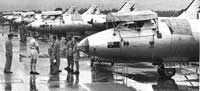
1963 Canberras from No. 2 Squadron lined up at Butterworth for an AOC's inspection |
The
Royal Australian Air Force was located at Butterworth in modern Malaysia.
RAAF Butterworth was transferred from the Royal Air Force to the RAAF
in 1957 and was home to numerous Australian fighter and bomber squadrons
during the Cold War. While RAAF Base Butterworth was closed
on 30 June 1988, the base remains active as RMAF Base Butterworth. |
Buildup
of Operational Units
Initially, a major problem for the RAAF was the
shortage of people and units, with the deployment of squadrons overseas
and in Japan, Korea and Malta, However these forces were returned to
Australia at the end of 1954 and the change of circumstances encouraged
RAAF planners to think more along the lines of a composite wing for
Malaya, including a headquarters, one bomber squadron, one fighter squadron,
a base squadron (administrative and logistical support) and a maintenance
squadron.
The build-up of the operational units at Butterworth and the growth of the base's population to about 1900 servicemen (including the Royal Malayan Air Force) and some 1400 Malayan civilians marked the start of what was to be a very productive and happy association with Malaya for the RAAF. Job satisfaction was high as Butterworth had a clear operational focus, initially on the Emergency and then on Indonesian aggression as President Sukarno began to implement his policy of Confrontation against the proposed Federation of Malaysia. Fulfilling work was complemented by living conditions which generally were extremely pleasant, notwithstanding persistent high levels of petty theft and disturbing communal riots in May 1969.
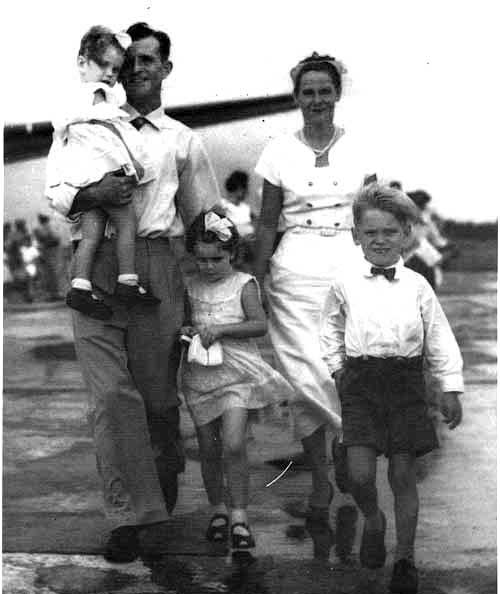
The colonial legacy was strong. In the 1950s and 1960s young RAAF officers and their wives could still take a first-class passage to Malaya on a cruise ship, meeting for cocktails in the late afternoon and dressing formally for dinner at the Captain's table. Many Air Force families lived in tropical bungalows on Penang Island, a fifteen minute ferry ride from the mainland.Penang was an exotic home, with its stylish mixture of Asian and British colonial architecture, the tropical vegetation and climate, a potpourri of races, spicy Asian food instead of stodgy meat and three vegetables, and a duty-free port invariably crowded with merchant shops from all parts of the world.
May 1958 |
Married quarters back in Australia occupied by families recently returned from Butterworth were often easily identified by their high-quality teak furniture. Asian objets, and state-of-the-art tape recorders, all bought at duty-free prices. The trappings of a privileged lifestyle were enhanced by tax exemptions and generous allowances. Included in those allowances was a payment for servants: three for air commmodores, two for other officers (a cook and a housekeeper), and one for airmen. Relieved of most domestic burdens, the Australians could settle into a lifestyle based on work for the men, followed by social activities centred on the service messes, the tennis club, the Penang Swimming and Golf Clubs, and the Runnymede and Eastern and Oriental Hotels. |
RAAF
School
Excellent conditions extended to dependants'
education. The decision to post families to Butterworth and set tours
at two to two and a half years meant that once the RAAF contingent had
reached its full strength, about three hundred Australian children would
be living in the Penang/Butterworth area. As only limited educational
facilities were available, the question of schooling had to be addressed.
The RAAF School on Penang Island
was built in 1962 to cater for a student
population of five hundred and fifty, aged from five to thirteen; high
school-aged children had to board in Australia or elsewhere in the peninsula.
Most teaching staff came from Australia. Within four years student numbers
had grown to seven hundred and fifty, creating a degree of overcrowding
which initially was addressed by the use of temporary huts. Permanent
extensions were made when it was decided in 1966 to deploy Mirage squadron
to Butterworth, a move which not only increased the student population
again, but also signalled Australia's intention to remain in the area.
Permanent accommodation for eight hundred and fifty children was approved
and the syllabus extended to include secondary education. The school
enjoyed a fine reputation.
Lifestyle
Overall the congenial lifestyle
tended to foster something of an enclave mentality. There was little
social contact between the RAAF people and the local community other
than the occasional official function. On reflection that was unfortunate,
but it was perhaps nothing more than typical of European-Asian relations
in those years.
The preceding sections are not intended to suggest that life on the Malay peninsula was a sinecure. Conditions undoubtedly were pleasant, but the fact remained that from the time Nos 1 and 38 Squadrons arrived in 1950 until at least the mid-1960s, RAAF squadrons in Singapore and Butterworth were on an operational footing. As late as 1971 Royal Malaysian Air Force strike aircraft could be watched taking off from Butterworth to attack the remaining pockets of communist terrorist resistance within one hundred or so kilometres of the base. The Australians were not directly involved in those operations after 1960, Britain having officially declared the Emergency 'over'. During the early 1960s the RAAF was, however, engaged in active service of a sort against Indonesia during the episode known as Confrontation.
______________________________
Extracts from "Going Solo The Royal Australian Air
Force 1946-1971"
© Alan Stephens
Reproduced by permission.
(Bold print emphases and headings mine)